
Of 115,000 EU laws, regulations, directives, & case law, UK has dodged 21,000 since Brexit
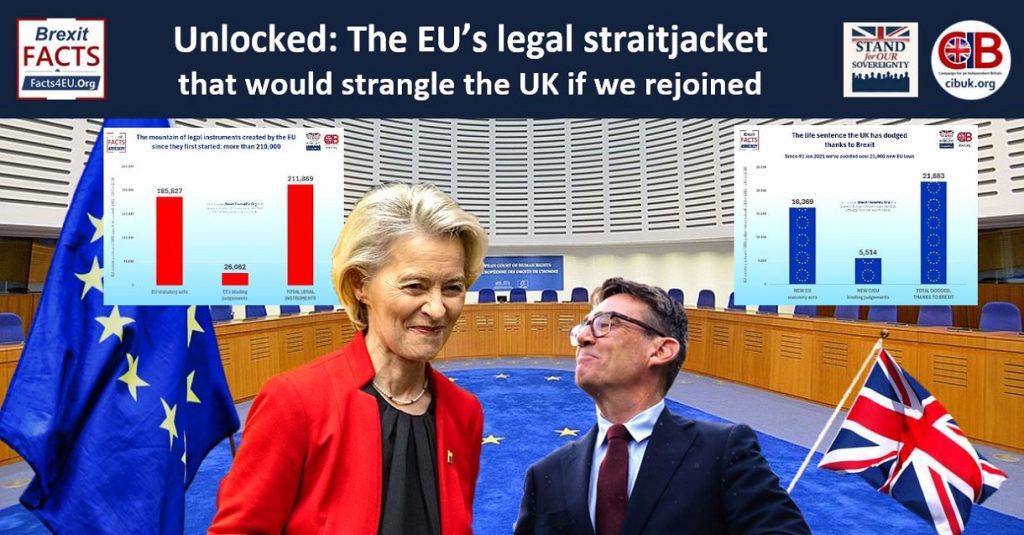
But, unelected EU Commission has 2,100 live legal cases against member countries,
And 10 live cases still raised against the UK, despite us leaving at end-2020
Revealed: 211,000 legal instruments created since the EU started. 115,000 are live and we would have to accept them if we rejoined. The UK has dodged 21,000 since 2020, thanks to Brexit. Plus, there are October’s 105 formal infringement decisions by the EU Commission against the EU’s member countries, to add to more than 2,000 active legal disputes already pending across the bloc.
Those who believe the UK should remain independent say British laws should be decided by our duly elected MPs in Westminster, rather than the UK being ruled over by unelected Brussels bureaucrats. The reality of what is involved in being under the direct jurisdiction of EU law is shocking.
The Stand for Our Sovereignty (SOS) team, together with colleagues at The think-thank Facts4EU and The Campaign for an Independent Britain (CIBUK.Org) have quantified exactly what it would mean to return to the EU from the perspective of the laws that govern us – for the first time we know of.
1. Just how big is the legal mountain the EU created since it started?
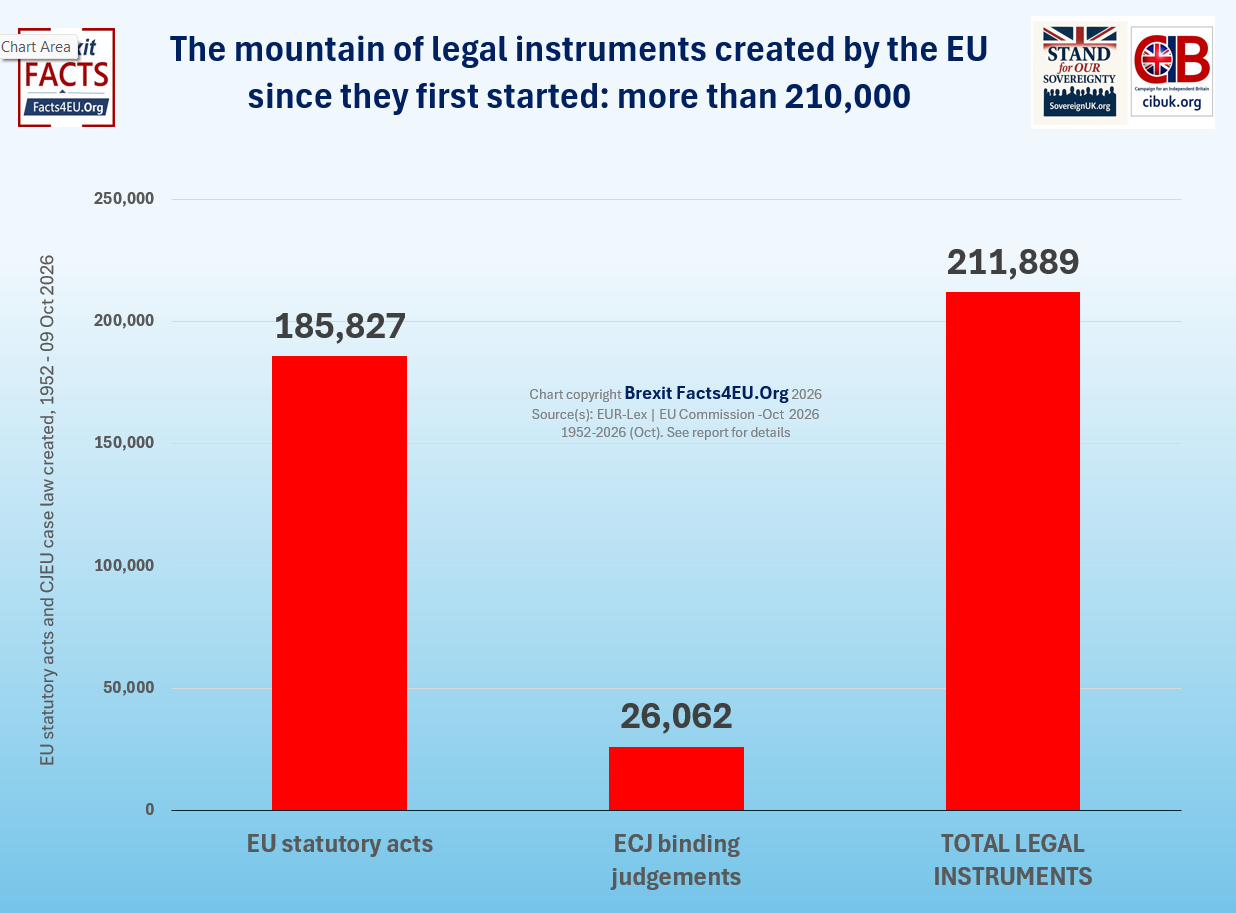
The historical volume of legal instruments created by the EU since its inception is simply vast.
The EU’s legal monolith
TOTAL: 211,889, as at 09 Oct 2026
- 185,827 EU statutory acts of one form or another, plus
- 26,062 binding judgements from the Court of Justice of the EU, (formerly the ECJ)
- TOTAL: 211,889, as at 09 Oct 2026
MPORTANT EXPLAINER: What exactly are we counting?
Some will doubtless say our figures are vastly overstated. They will base this on superficial internet searches, often using AI, or by looking at government statements. To be clear, we went direct to the source – the official EUR-Lex database. The government’s own legislative figures are far less. However, we have not only counted primary legislation, but the entire, all-encompassing body of the EU acquis currently in force on that database.
From a strict operational perspective, any member country must take into account all active legal instruments and the vast mountain of evolving EU case law. No nation can simply ignore these administrative acts, as they form part of a binding legal architecture that national governments and courts must constantly monitor and obey to avoid prosecution.
Whether counting primary statutes or daily administrative decrees, the political reality remains identical: the sheer volume of incoming rules creates a cumulative regulatory load that completely dwarfs independent domestic law-making.
If readers want an image of this explainer for use on social media, here it is.
2. “Britain Behind Bars” – What would the UK have to absorb if it joined the EU tomorrow?
For those advocating for a return to the bloc, the entry price is an all-or-nothing requirement to absorb the acquis communautaire – the accumulated body of EU law.

Clearly, over the years some of the legal instruments totalled above have been repealed, changed, or replaced. We therefore then analysed the ‘functional corpus’ of all legal instruments which the UK would be required to absorb if it were to rejoin the EU, as Andy Burnham wants.
In practical terms, the operational load is currently an extraordinary 115,707 active instruments.
This number comprises the total of all active legal documents and represents the day-to-day legal reality which a joining country must instantly absorb and comply with, on a daily basis.
BEFORE WE CONTINUE…
Please support our work
If more patriotic members of the public donate, we will keep going.
Please donate today to our research partner, Facts4eu, if you would like to continue reading us tomorrow, next week, and the weeks after.

Rt Hon Lord Redwood D.Phil FCSI, former Single Market Minister and former Secretary of State
commented exclusively to Stand for Our Sovereignty and Facts4EU

“Facts4EU excel themselves by reminding us of the EU elephant in the room: the vast body of EU law that dictates to member states regardless of their wishes and needs. They reveal the massive scope of the EU ‘s power grab.
“They remind us we have escaped thousands of new laws and Court judgements since we left.
“It reminds me of how powerless the UK was when we were members to stop the torrent of legislation. As Single Market Minister all I could do was delay or dilute the worst of it. Only the Commission could write the laws.
“They made relentless efforts to take ever more areas out of member state democratic control. They knew how to create majorities of states to drive the agenda.
“There is no official Opposition to test out or block bad new EU laws in the way we do in Parliament.”
3. The life sentence the UK has dodged by leaving
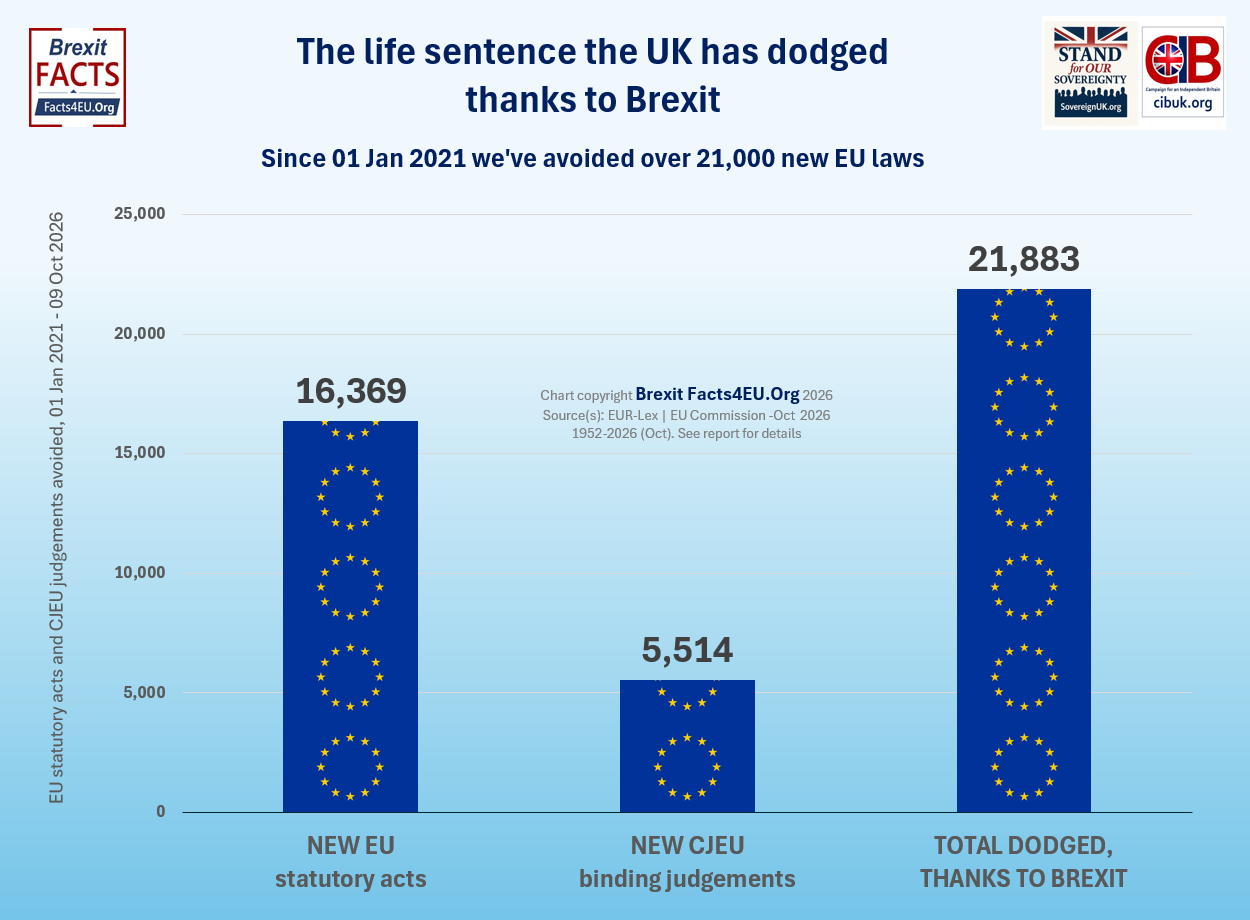
Next, we examined how many new legal instruments the UK has avoided by leaving the EU. Our analysis of the enormous EUR-Lex database has captured all EU laws, directives, regulations, and rules that must be followed by member countries, plus it also sweeps in all binding, post-Brexit judgements handed down by both the EU’s courts (‘EU case law’).
From a strictly legal point of view, the UK officially stopped automatically having to implement new EU laws and follow new case law at 11:00pm on December 31, 2020. This marked the exact end of the Transition Period and the chart shows what has happened since then.
Thanks to Brexit
(Sources: EU’s official EUR-Lex database & the EU Commission, Oct 2026.)
Note: While 5,514 EU Court judgements in under six years seems high against a historical total of 26,062 since 1952, it reflects the latest multi-court EU system. This large legal machine now pumps out close to 1,000 rulings a year across 27 nations, compared to the much smaller tallies of the bloc’s early decades.
4. Who actually writes this mountain of law?
Crucially for British voters, the laws governing member states do not originate from elected parliamentarians. Under the EU’s constitutional treaties, the unelected EU Commission holds an absolute monopoly on the “right of initiative.” These are then added to by EU judges as ‘case law’.
Neither the directly-elected EU Parliament nor national parliaments can draft or introduce a new EU statute. They can only amend, delay, or vote on what Ursula von der Leyen’s executive puts in front of them.
Neither can countries disobey judgements of the EU Courts of Justice.
This means the primary legislative engines remain structurally isolated from direct democratic accountability.

5. Why is the UK still being prosecuted six years after leaving?
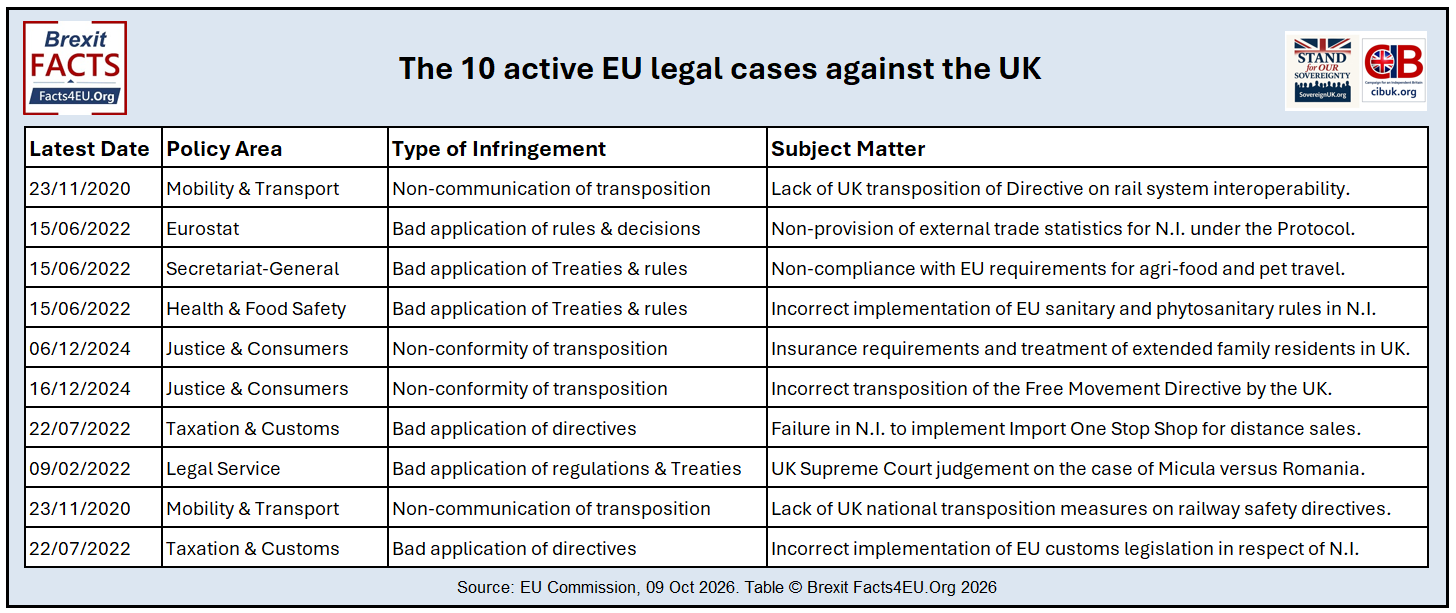
The final element of our analysis exposes the administrative ties that Britain has yet to fully sever. Ursula von der Leyen’s Commission still maintains 10 active infringement cases against the United Kingdom, outlined in the table below.
While the British mainland successfully regained its statutory sovereignty on December 31, 2020, legacy clauses embedded within the Withdrawal Agreement and the Northern Ireland Protocol left a lengthy legal tail.
In terms of importance, these 10 ongoing prosecutions vary but primarily centre on disputed interpretations of EU citizens’ residency rights and cross-border customs checks in the Irish Sea. Until these specific treaty obligations expire or are settled, Brussels retains the unique legal authority to drag the UK before its Courts of Justice.
(Source: The EU Commission, Oct 2026.)
6. Finally, the proof the UK didn’t leave until 2021
Finally, and despite what was stated by the government in early 2020, they did not “get Brexit done” on 31 January 2020. Whilst the UK “formally” exited the EU on that date, under the terms of the Withdrawal Agreement a temporary transition framework was established.
During this transition period, EU law continued to operate in and apply to the UK exactly as it had before. British courts remained bound by the judgements of the EU Court of Justice (CJEU) and the UK was also legally required to adopt all new regulations and directives churned out by Brussels during those 11 months.
It was only when the clock struck midnight in Brussels (11:00pm in London) on December 31, 2020, that the transition window slammed shut. At that precise moment, the European Communities Act 1972 was formally repealed, and the direct jurisdiction of EU law over the British mainland ended.
The Rt Hon the Lord Redwood D.Phil FCSI gave us his final comments
“No wonder the EU economy is so sluggish, constantly disappointing today’s voters in France, Germany and many other member states. It is so bad one of the EU ‘s greatest figures, Mr Draghi – the saviour of the Euro, wrote a big report about the devastating impact on growth and prosperity from too many laws.
“Facts4EU had the patience to count the thousands of often costly anti-enterprise, unhelpful rules and judgements that are holding the economies back. Europeans are not by birth more stupid or lazier than Americans so there has to be a reason why the US has dramatically outgrown Europe this century and now has GDP per head around double the EU average.

“US common law lets businesses do anything that is not banned. EU code laws set out in a vast library of laws what you are allowed to do.
“The US system delivers prosperity. The EU brings high costs, business frustration and less growth. UK voters understood this when we voted to end oppressive EU law. Pity many of our politicians and civil servants still haven’t got it.”
Observations
Ursula von der Leyen proudly proclaims the EU as a bloc that is built on the rule of law. It might be more correct to say it is built on an ever-growing morass of tens of thousands of EU laws which are increasingly controlling every aspect of the lives of the citizens of the member countries.
This report clearly shows the British people were right. The mountain of EU laws over which no-one in the UK would have any say is intolerable for any democratic nation state. The very idea is preposterous.
Given the huge numbers of legal instruments we would now be weighed down under – were we to follow Andy Burnham’s wishes and rejoin – is simply too heavy to bear and should never again be inflicted on the United Kingdom.
Please help us to carry on our vital work in defence of independence, sovereignty, democracy and freedom by donating today to our research-engine: Facts4EU.Org or becoming a Member of Stand for Our Sovereignty. Thank you.
Please support our work
If more patriotic members of the public donate, we will keep going.
Please donate today to our research partner, Facts4eu, if you would like to continue reading us tomorrow, next week, and the weeks after.
[ Sources: Office for National Statistics | Eurostat | Labour Conference | Keir Starmer press conference ] Politicians and journalists can contact us for details, as ever.