
The fractured continent: How the EU’s electorate has been rewriting the map
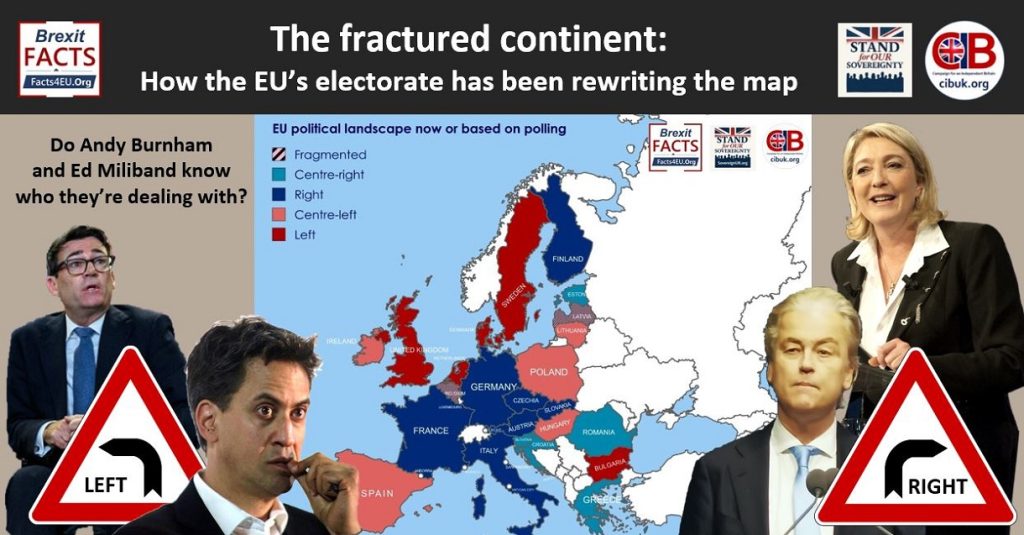
The EU’s democratic earthquakes in two revealing maps
For Andy Burnham to achieve the best result for the UK from his upcoming Summit with the EU, he may first wish to check the political temperature across the bloc. Or rather, temperatures – in the plural. At national level, the EU is a very different beast than it was when Sir Keir Starmer took office.
In another exclusive for GB News, Stand for Our Sovereignty (SOS), together with colleagues at The think-thank Facts4EU and The Campaign for an Independent Britain (CIBUK.Org), have analysed the trends across all 27 EU member countries and produced two contrasting and highly illuminating maps.
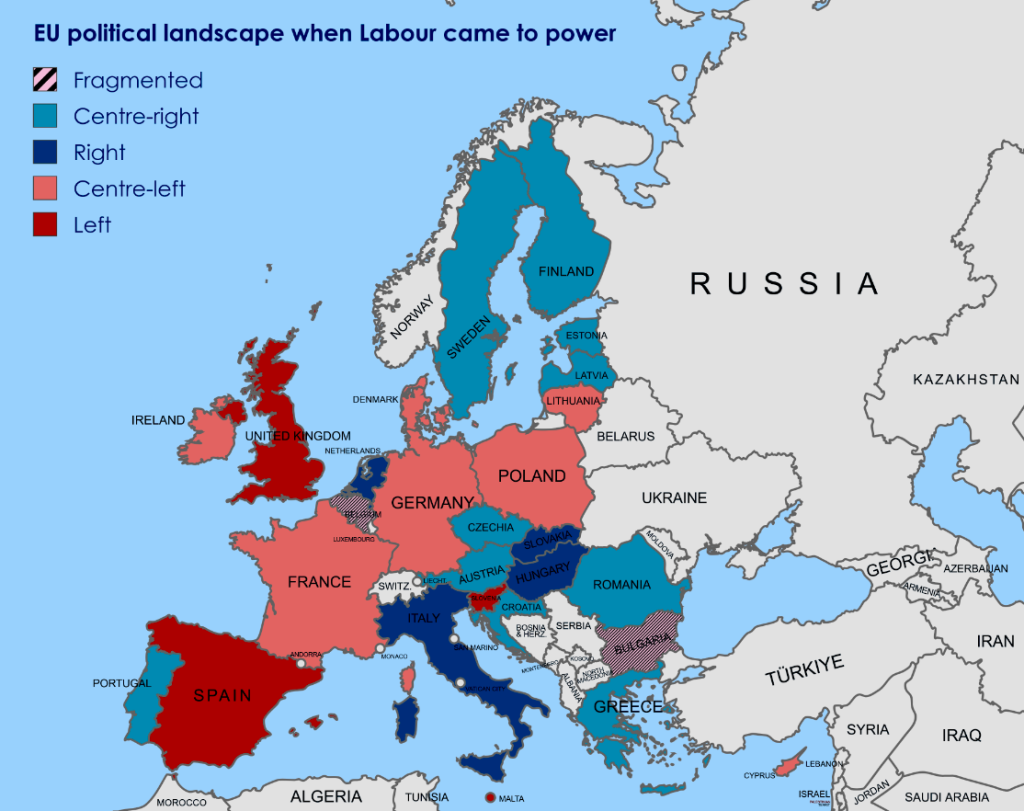
1. The EU when Labour took power
versus
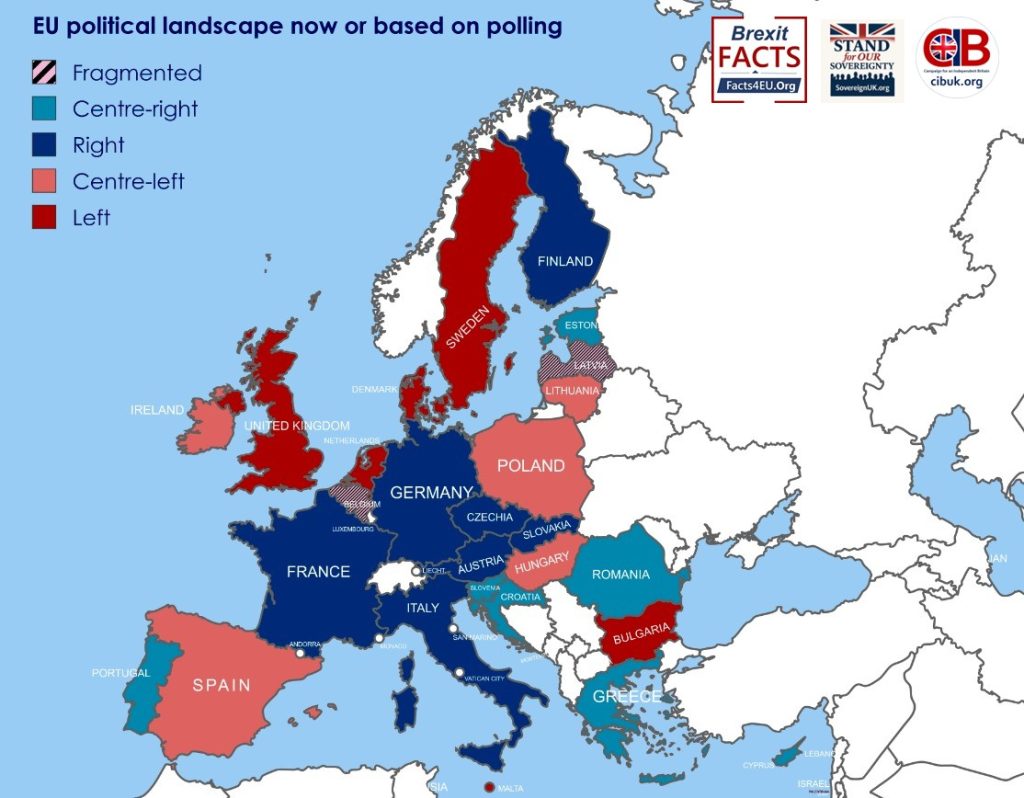
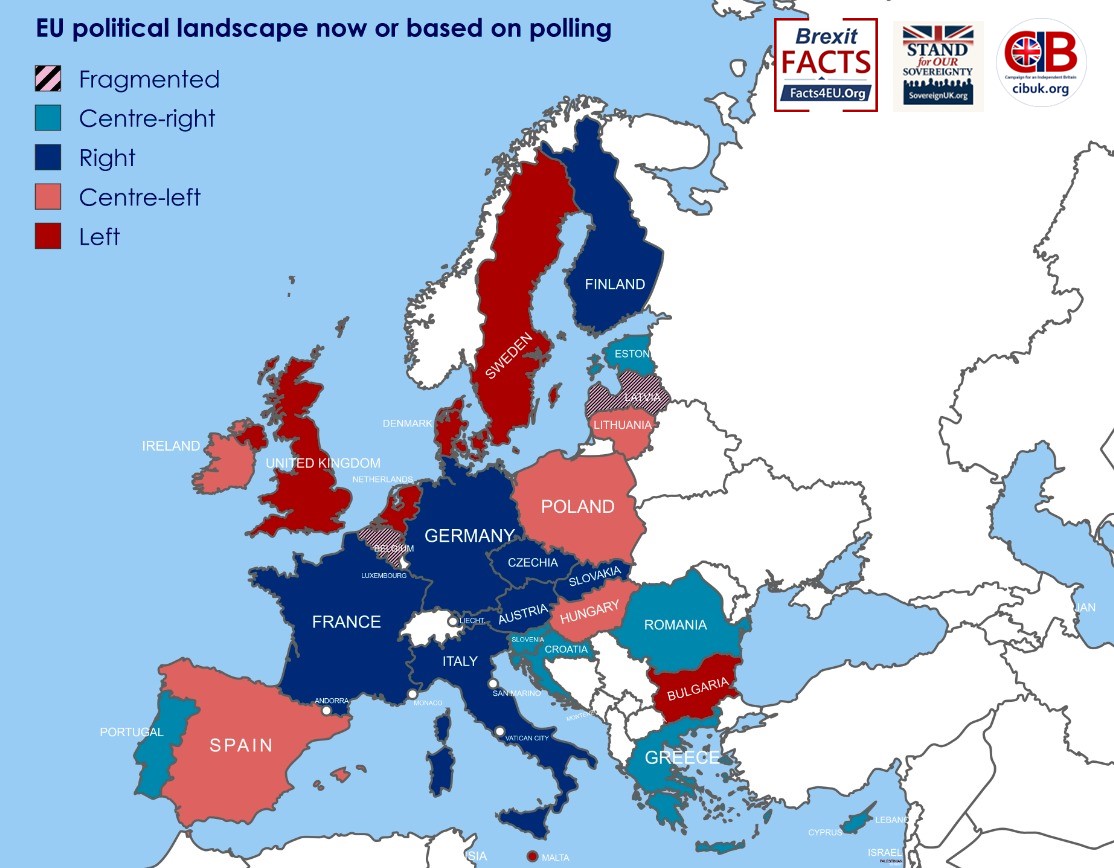
2. The EU’s political temperatures now
The results have real-life implications
for Andy Burnham’s renewed ‘Re-Set’
The illusory world outlined by the PM in his Labour Conference speech
“Brexit has done more harm than good. We need to restore a higher level of growth and prosperity for Britain.
“So, I will take the opportunity around the summit to lay out to you, to lay out to the country, what I believe the different options are for Britain’s long-term relationship with our European partners.”
– The Rt Hon Andy Burnham MP, Labour Party Conference, Liverpool, 29 Sept 2026
Next week we will challenge the Prime Minister to support his empty words with facts. He will be unable to back his statement that “Brexit has done more harm than good” with any evidence, as we shall demonstrate. In the meantime, below we deliver a lesson in the EU he will now be dealing with.
Those halcyon days for Labour in 2024…
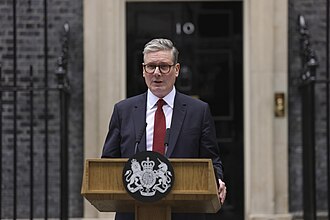
When the Labour government swept to power in the election on 04 July, 2024, the massive majority it secured promised to deliver a period of stable, centre-left government.
In London, the diplomatic mandate from Sir Keir Starmer seemed simple: initiate a constructive “Re-Set” with EU partners to boost growth.
However, map out the European Union’s political complexion on that summer day in 2024, and you find a landscape that bears almost no resemblance to the volatile, fractured continent confronting Andy Burnham today.
Our first map captures the EU as it stood when Sir Keir Starmer entered Downing Street
The map below reveals a sea of coalitions dominated by traditional centre-right blue and centrist pink alliances trying to maintain a predictable, pan-EU status quo.
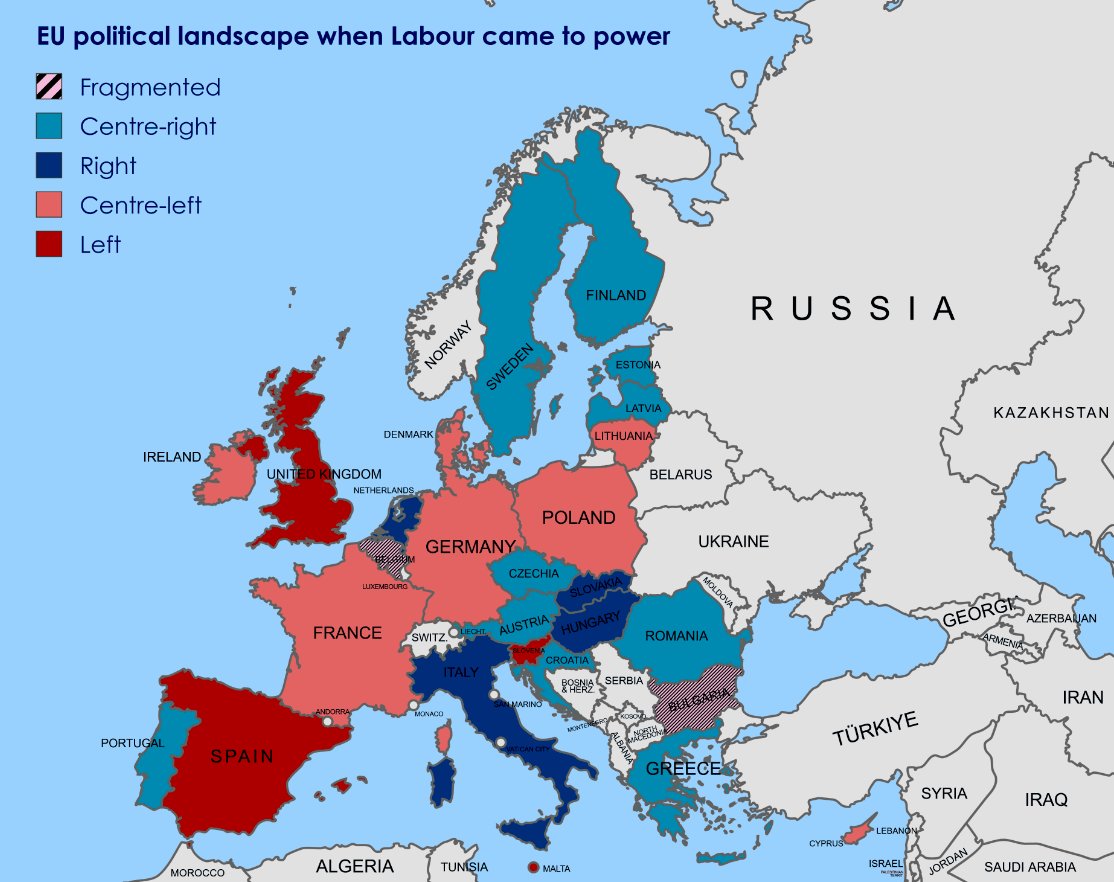
Aside from isolated nationalist holdouts, the EU’s centre held. This was a Brussels the Labour government broadly understood.
Our second map shatters that baseline assumption entirely
The visual shift since Labour came to power is immense.
Some of these changes are ‘locked in’ because elections have taken place. The other changes in the map below reflect polling ahead of elections coming up during this Labour government’s tenure. Whilst the latter are only the latest snapshots of the electorate’s mood in those countries, and elections themselves may produce different results, the views of their electorates will be influencing the governments in those countries.
The traditional, moderate centre has crumbled, giving way to a wedge of nationalist ‘dark blue’ slicing directly through the traditional engine rooms of the EU, only partly counter-balanced by radical shifts to the left and centre elsewhere.
BEFORE WE CONTINUE…
Please support our work
If more patriotic members of the public donate, we will keep going.
Please donate today to our research partner, Facts4eu, if you would like to continue reading us tomorrow, next week, and the weeks after.

The collapse of the Western engine for Mr Burnham
If polling is to be believed, several key EU member states will either go right-wing at their next elections or their government’s policies will be being influenced by the right-wing threat. In Germany, the populist, far-right Alternative for Germany (AfD) leads national polls at 27% and has now started winning regional elections.
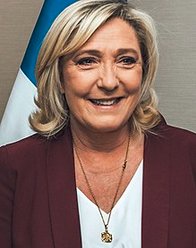
In France, President Emmanuel Macron’s fragile centrist pink arrangement is on course to being overwhelmed by Marine Le Pen’s National Rally, which dominates presidential surveys for next year’s election at a commanding 34%.
Given the new accord with Nigel Farage’s Reform UK, will Andy Burnham start building bridges?
Across Austria and Czechia, the map turns a solid dark blue as right-wing populist forces firmly establish leads.
The Rt Hon the Lord Redwood D.Phil FCSI, former Secretary of State,
commented exclusively to Stand for Our Sovereignty, Facts4EU and GB News

“The UK government’s dream of an EU Re-Set that would miraculously boost growth and vanish away the budget troubles was always unlikely. Political change on the continent makes it impossible.
The EU needs big new tax revenues of its own to increase the spending in troublesome states. It wants to strengthen its stranglehold over law-making to head off wayward policies. It is out to control what people can say in member states as it tries to block the path of populist parties to power. It sees the AFD and National Rally as threats to its future plans of grabbing more money and power to the centre.
“This means an even tougher set of demands on a weak UK begging to be loved. There will be no wins for the UK, only humiliating surrender to their terms. We will pay more bills and import more from them with no wins for us.”
The increasing right-wing influence in the power blocs
This rightward shift has fundamentally altered the diplomatic and political arithmetic for London. As Chancellor John Healey must surely have noted following engagements with European finance ministers, the emerging right-nationalist bloc is more transactional.
Rather than engaging in broad, idealistic treaties, these capitals view the UK through a protectionist lens – as evidenced by the ongoing row over the EU’s “Made in Europe” procurement barriers, as reported here on Tuesday.

The increasing right-wing influence in the power blocs
This rightward shift has fundamentally altered the diplomatic and political arithmetic for London. As Chancellor John Healey must surely have noted following engagements with European finance ministers, the emerging right-nationalist bloc is more transactional.
Rather than engaging in broad, idealistic treaties, these capitals view the UK through a protectionist lens – as evidenced by the ongoing row over the EU’s “Made in Europe” procurement barriers, as reported here on Tuesday.

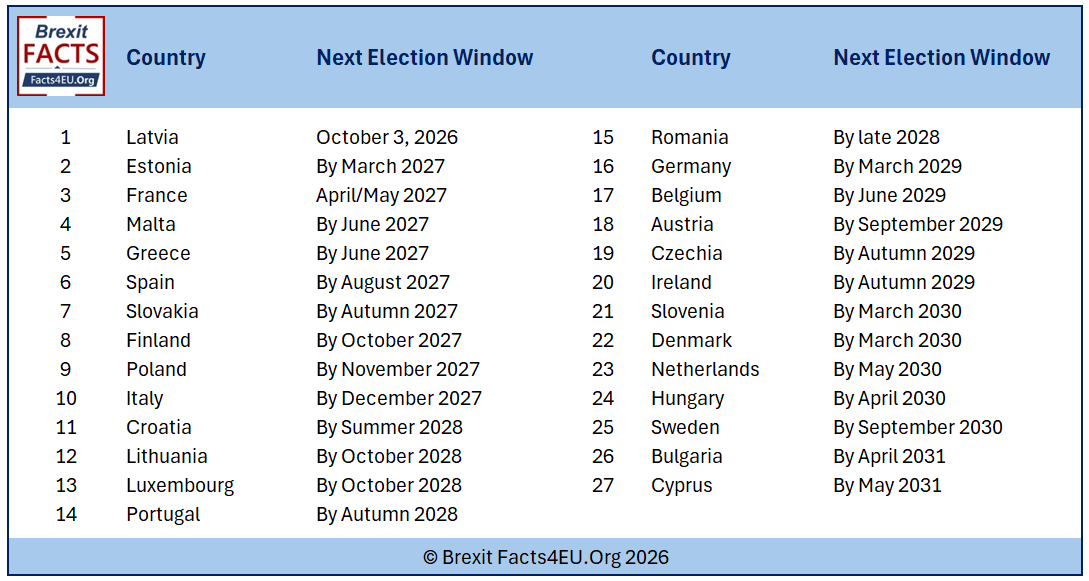
Likely dates for national elections across the EU27
The following table shows the approximate dates for elections to national parliaments in the EU’s 27 member countries. Naturally these are subject to change and some will doubtless occur sooner.
The Nordic counter-surge
However, as our second map above demonstrates, the UK can no longer treat the EU as a monolithic bloc that moves in a single ideological direction.
While Central and Western Europe harden into ‘dark blue’, Scandinavia is experiencing a sharp progressive counter-surge that pulls the map in the opposite direction.
Following volatile election cycles, Sweden and Denmark have turned left.
In the Netherlands, the collapse of the recent right-populist-influenced coalition government has produced a social-liberal counter-surge.
For a Labour government, these northern capitals are more receptive to shared environmental standards, synchronised labour laws, and integrated energy grids. Navigating this means London must learn to play a double game: managing a relationship with a nationalist core in Paris and Berlin, while forging ‘progressive’ alliances with the far-North.
The shock reversal in the East
The final, most dramatic visual transformation on our second map occurs in Central Europe. For well over a decade, Hungary stood as the immovable, ‘dark blue’, nationalist anchor of anti-EU sentiment.
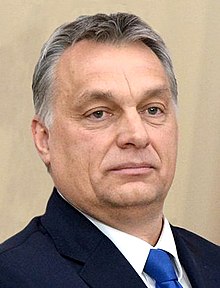
In April’s general election, Viktor Orbán’s 16-year rule was annihilated in an historic result. Péter Magyar’s pro-EU, centrist opposition party, Tisza, won the largest number of votes and the highest percentage of seats of any Hungarian political party since the fall of Communism.
Concluding comments from ex-Secretary of State Lord Redwood,
exclusively to GB News, Stand for Our Sovereignty and Facts4EU
“Why can’t the UK government see what Facts4EU brilliantly sets out? That the EU is under strain and splitting between populist right and left? This means the EU will demand even more of a weak UK. Does Labour want a love in with the AFD?
“The EU want a big UK financial contribution. They want to lock us in to their dear energy and high carbon tax scheme. They want to stop our businesses benefitting from innovations made impossible by EU rules. They want to undermine our Free Trade Agreements with the rest of the world. They will make us impose taxes on imports from non-EU countries (their carbon border tax) and reimpose tariffs, with more taxes on UK consumers.

“The EU will be riven by big rows between the new nationalist populists and the far left. All they will be able to agree is an even worse deal for any country stupid enough to want to cosy up to them. Maybe a rainbow appears amidst the EU storm but there is no pot of gold for the UK at its end. We will just get soaked.”
Observations
The implications for Labour’s Re-Set
For Downing Street, the final takeaway from these two maps is that the stable, moderate EU that existed when Labour won power in July 2024 is gone. Many elections have not yet taken place but the mood of the electorates is clear. In its place stands a more transactional, volatile continent split into fragments.
As Chancellor of the Exchequer John Healey prepares his upcoming budget, commentators are saying the UK can no longer afford to harmonise with a shifting European rulebook. By the time of the UK-EU Summit, pencilled in for December, Mr Healey might expect a hardening of EU attitudes to the point where deals become too expensive even for this free-spending government.
If the government is determined to continue with its “Re-Set”, as it most definitely seems to be, then it must go into the coming EU-UK Summit with a sharp, sophisticated strategy capable of navigating a continent divided against itself.
As things stand, this looks increasingly improbable.
Please help us to carry on our vital work in defence of independence, sovereignty, democracy and freedom by donating today to our research-engine: Facts4EU.Org or becoming a Member of Stand for Our Sovereignty. Thank you.
Please support our work
If more patriotic members of the public donate, we will keep going.
Please donate today to our research partner, Facts4eu, if you would like to continue reading us tomorrow, next week, and the weeks after.
[ Sources: EU Council | EU Commission | EU Economy Commissioner X feed | OECD | SMMT | House of Commons Library ] Politicians and journalists can contact us for details, as ever.