
The truth about the border, the ‘Common Travel Area’, and criminals coming from EU countries
A Special Analysis into one aspect of the tragic event in North Belfast on Monday
With in-depth research from Facts4EU, The Campaign for an Independent Britain, and Stand for Our Sovereignty, the Special Projects team at GB News brings readers the full, unvarnished, and shocking facts.
We would encourage all readers please to join Stand for Our Sovereignty, to allow us to cover many more important stories relating to the UK’s sovereignty.
This exclusive report for GB News by Brexit Facts4EU summarises one element behind the brutal stabbing in Belfast about which little has been reported with any authority.
Whilst there are many details which have still not been released, some are now known, including the fact the suspect entered the UK – specifically Northern Ireland – from an EU country: the Republic of Ireland.
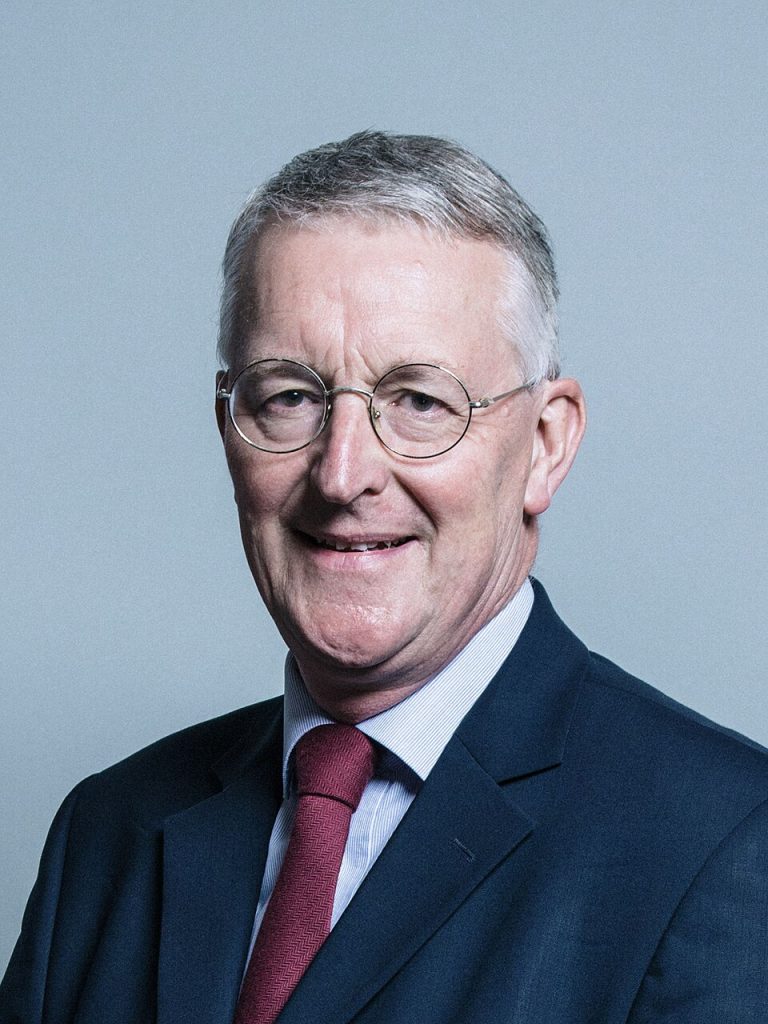
“The Home Office confirmed yesterday afternoon that the individual is a Sudanese national with leave to remain in the UK until 2028. He entered the UK in 2023 and was granted refugee status the same year. The suspect says that he travelled from mainland Europe to Dublin and then on to Belfast where he claimed asylum.”
Written Statement, Secretary of State for Northern Ireland Hilary Benn MP, 10 Jun 2026.
So, we know that once in the UK the Home Office almost immediately granted him leave to stay for five years.
It’s not (yet) a crime to discuss immigration
The terrible events have naturally provoked many questions, responses, statements, accusations and comments. Nothing is more important than the victim and his family but it is nevertheless important that all aspects surrounding this event be analysed.
This includes an element that until recently was not able to be discussed without knee-jerk reactions from certain parts of the political landscape, entailing accusations of “racism” and “stirring tensions”. We are talking, of course, about the question of the immigration status of the suspect. GB News is not afraid of confronting this.
Immigration and the role of the EU
The tragic events of this week in Belfast have once again shone a light on the North-South border on the island of Ireland. Most British and Irish citizens are aware of something called the Common Travel Area which unites their countries. Many will know this dates back to the secession of 22 counties of the Republic in the early 1920s and the formation of the Irish Free State.
There have been a great many changes in the rules of the Common Travel Area over the past 100 years, including its complete suspension for many years from the start of WWII in September 1939. For most of the latter part of its existence, however, one thing has been clear: the CTA applies only to British and Irish citizens, NOT to the EU’s illegal migrants.
Suspect had no ‘Common Travel Area’ rights, he is an EU illegral migrant
The suspect in the stabbing in Belfast this week clearly has no rights under the Common Travel Area. This puts his presence in the Republic and then in Northern Ireland squarely within the confines of being an “EU illegral migrant”.
It seems he had travelled from his home country of Sudan to an EU country, France. He was then able to travel to another EU country, the Republic of Ireland. Finally, it is believed he caught a bus from Dublin to Belfast. The EU has a treaty obligation to be a good neighbour to surrounding countries. In this case – and in 180,000 others since 2018 – it has allowed an illegal migrant to enter its territory and apparently to travel freely, with no checks, detention or any other impediment.
We now know the terrible consquences of the EU’s inaction.
None of this is new – the problems have been brewing in the EU and Ireland for many years
It was one year ago to this same week that we were watching and reading about a week-long duration of riots in Northern Ireland. So serious were these, we saw the reports in newspapers from all around the world.
In that case, once again it was immigration that provoked the disorder. The violence stemmed from a case that had horrified the Province as well as places further afield. As many readers will recall, two Roma boys had been charged with the attempted rape of a teenage girl in the Ballymena area.
Population displacement
The background here is important. During the previous 10 years the population churn in the area had exceeded 50%, to a large extent as a result of Roma people having bussed in large groups from their communities in the Republic. Naturally this had completely changed the nature of this part of Ballymena.
Critically, it was alleged that whilst the EU (and its puppets in the N.I. Office and Whitehall) cared a great deal about supervising the North-South border in respect of UK goods, it made no checks on people moving from the South to the North.
Ballymena MP and Leader of the TUV, Jim Allister KC MP, spoke exclusively to us

“The problem facing Northern Ireland is that while the Government has demonstrated extraordinary devotion to policing the border with the Republic of Ireland in addressing illegality, as defined by the EU, in relation to the movements of plants and goods through the Windsor Framework, it has demonstrated no interest in protecting UK citizens in Northern Ireland from violent immigrants.
“In other words, rather than serving the best interests of UK citizens in Northern Ireland the UK Government has acted against the best interests of its citizens in strictly enforcing one aspect of the border, while simultaneously acting against the best interests of its citizens by not enforcing another aspect of the border.”
Jim Allister KC MP, exclusive comments, 10 June 2026
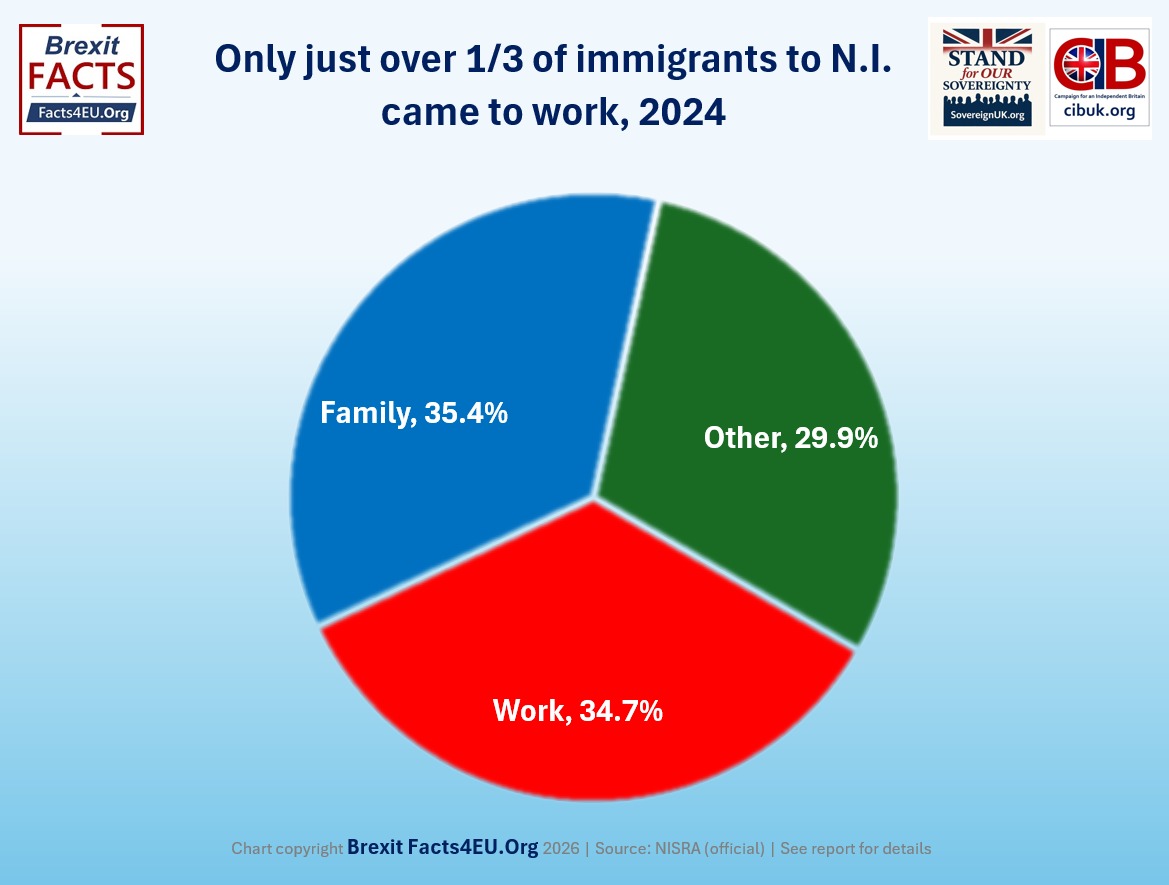
Immigration in Northern Ireland – only just over one-third come for work
Below are the latest figures from the Northern Ireland Statistics and Research Agency,
for Jan-Dec 2024
Back to Belfast
In percentage terms, the population of places like North Belfast has not changed as much as in some parts of N.I.. Some of these areas are, after all, amongst the most deprived in the United Kingdom and therefore less appealing. Nevertheless, the population divides in Northern Ireland are highly sensitive and this is often not understood on mainland GB. The ‘community’ you are from is fundamental to who you are, and where you dare walk alone at night.
Yes, the Belfast (Good Friday) Agreement – which had nothing to do with the EU – made a difference to the visible levels of violence, but sectarianism remains a powerful force under the surface. The influx of even relatively small (by mainland UK standards) members of other communities as a result of immigration from the EU is enough to disturb the fabric.
When an illegal migrant, such as the suspect in this case, allegedly commits such a heinous act, tensions are always going to rise higher than elsewhere in the Kingdom. When the nature of sectarian violence from the Troubles is still embedded in the public consciousness, these tensions can spill over into the forms of violence we have seen.
The EU’s culpability
Ultimately, say the Unionists and those who are pro-Brexit, this is about the consequences of the EU completely failing to understand that its entire policy on Northern Ireland has been wrong from the start.
The UK Government shows no signs of calling out the EU on its inability to control its borders and instead the Home Secretary, Shabana Mahmood, has thrown another £600m+ of public money to France to do a job which it might be thought is its own responsibility to perform and pay for.
“Time to police the border,” Jim Allister KC MP tells us
“In the context of this week’s events, the pressure is now mounting for the UK Government to police the land border. They now need to grasp that nettle.”
Jim Allister KC MP, exclusive comments, 10 June 2026