Andy Burnham is set to inherit the most interventionist policy for a generation
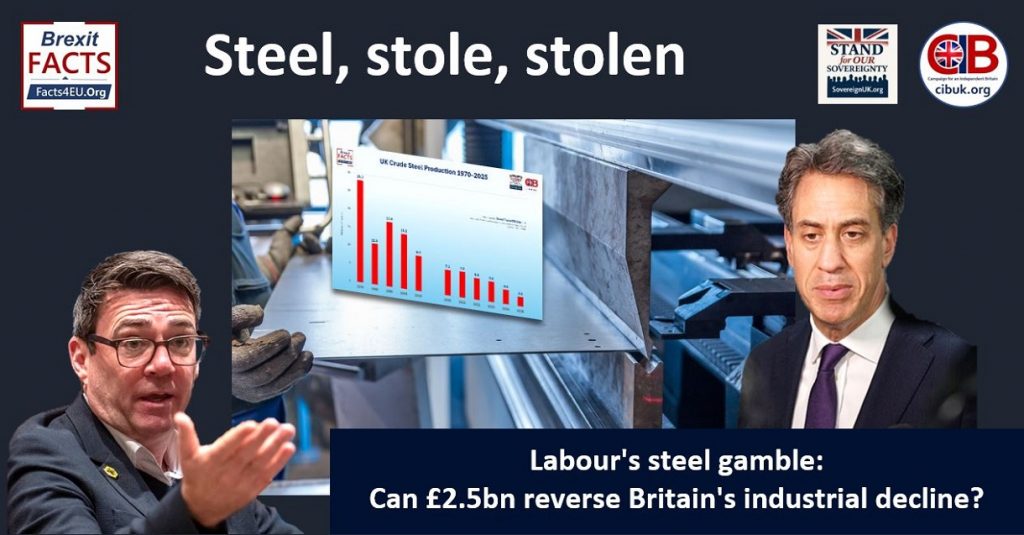
New quotas and tariffs to put even more pressure on British industry
When Tata Steel’s blast furnaces at Port Talbot fell silent last year, Britain lost most of its ability to produce primary steel. By the Labour Government’s own admission, primary steel is essential for national security. Today, it is betting £2.5 billion that it can rebuild the industry – not by restoring the past, but by reinventing it.
The Government has unveiled the most interventionist steel policy for a generation, combining tougher import protections with the investment, ostensibly designed to halt the industry’s long decline.
This report by Facts4EU in association with The Campaign for an Independent Britain, and Stand for Our Sovereignty summarises what some see as a potential disaster in the making for Andy Burnham, which will feature in the news for many months if not years. This report has been shared exclusively in advance with GB News.
“Steel built our past. It will shape our future.”
– The Rt Hon Peter Kyle MP, Secretary of State for Business and Trade, 20 Mar 2026
The urgency is clear
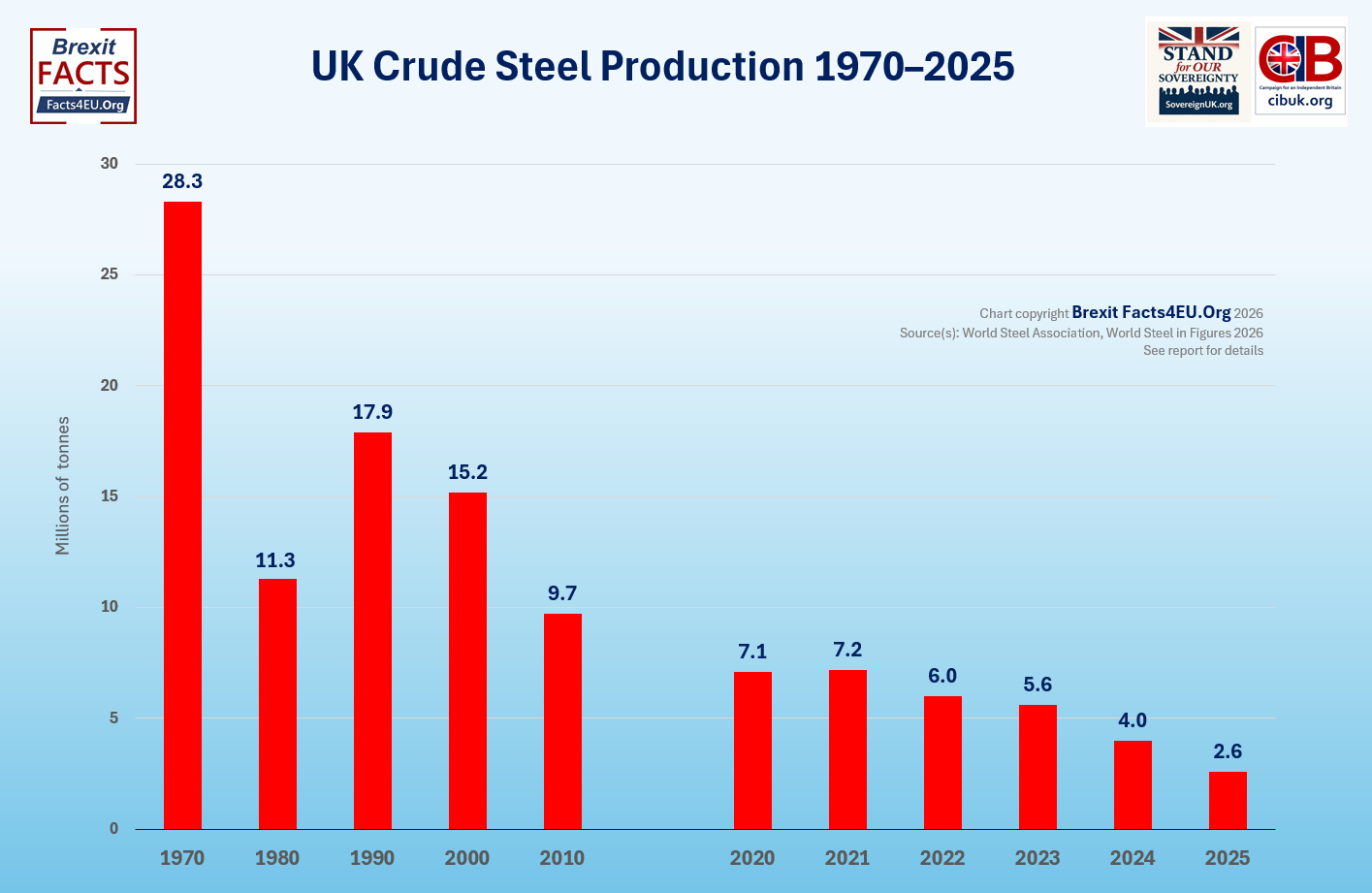
The challenge facing Labour is immense. UK crude steel production fell to just 2.6m tonnes last year, according to the World Steel Association. This is the lowest level in the modern era and a dramatic fall from more than 28m tonnes in 1970.

The humbling of the steel industry, 1970-2025
Labour has pledged that up to half of the steel used in Britain should eventually be produced domestically, compared with around one quarter in 2025. It has also pledged to increase the proportion of UK-made steel used in public procurement and to address the high industrial electricity prices that manufacturers have long-argued place them at a competitive disadvantage.
Whether this represents the beginning of a genuine revival – or simply a very expensive management of long-term decline – remains the central question.
Net Zero and Ed Miliband are all part of this
At the heart of this is the transition to electric arc furnaces (EAFs). Unlike traditional blast furnaces, EAFs recycle scrap steel using electricity, dramatically reducing carbon emissions and aligning steel production with the Government’s wider net-zero ambitions.
The flagship project is Tata Steel’s £1.25 billion investment in a new electric arc furnace at Port Talbot, backed by £0.5bn of government funding, first agreed under the previous government. The Labour government seems to be using the overall £2.5bn earmarked for the industry to pay for the huge losses at Scunthorpe instead of mirroring the Tata investment with a new Scunthorpe arc furnace.
“The government is living a contradiction,” Lord Redwood tells GB News, Stand for our Sovereignty and Facts4EU exclusively

“The government says it will save the UK ‘s last two blast furnaces and the 4,000 jobs at Scunthorpe, and – at the same time – that it remains committed to an all-electric, steel-producing future. This means closing the furnaces and sacking many of the people.
“It needs to make up its mind and tell the truth to its employees.
“Its failure to acquire the company and assets could cost us dear, as the owner claims compensation. The huge losses at more than £500m a year are eating through the £2.5bn cash the government planned to spend on new steel investment. They could end up closing the loss-making plant without a new electric arc plant to replace it.
“The government still will not publish a plan on how to cut the losses, how to sell the steel, nor how long the plant can run for.”
The UK has become ‘the poor man of Europe’
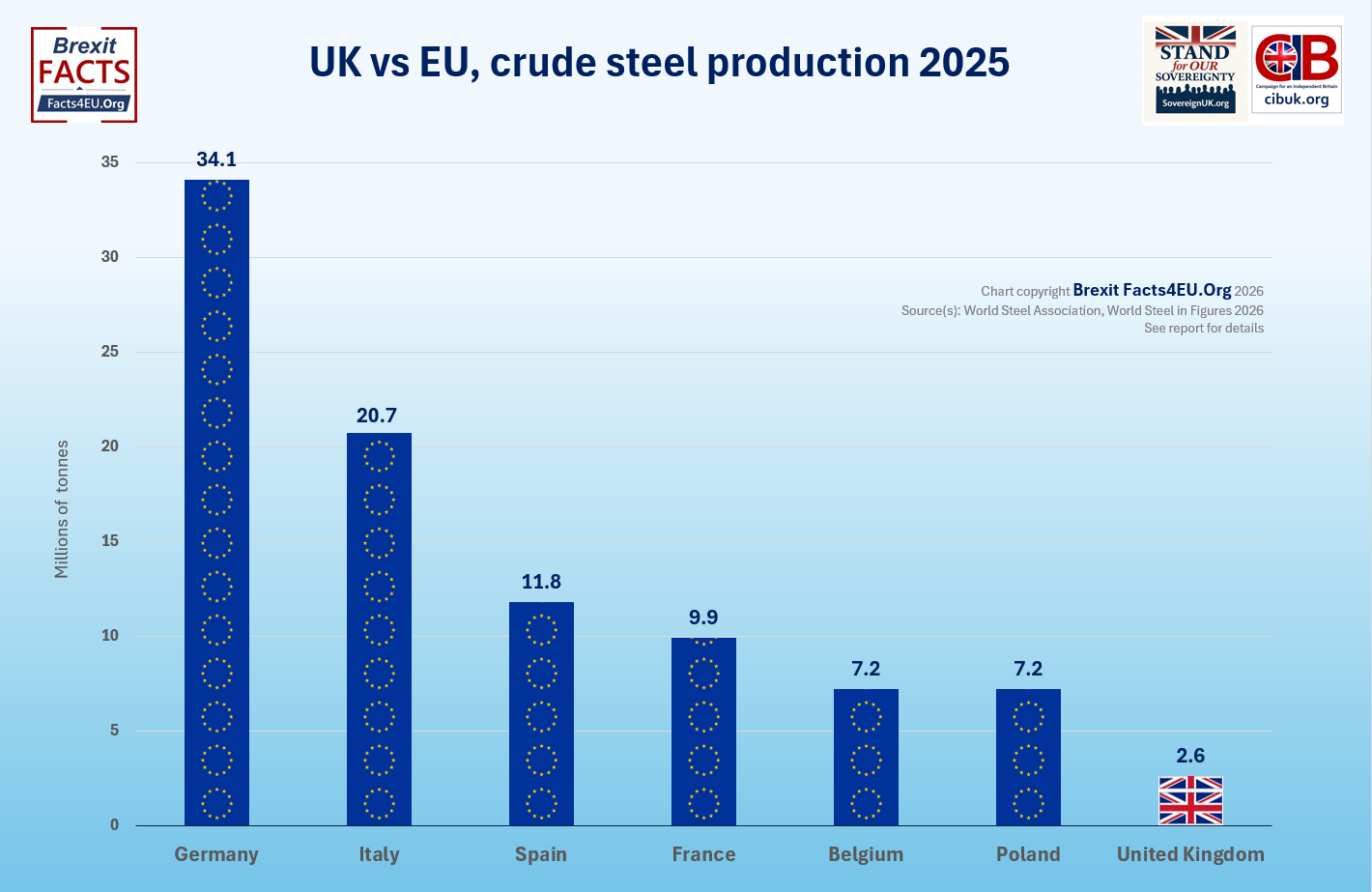
Last year, Britain produced only just over 1/3rd of the steel produced by smaller economies in the EU such as Belgium or Poland.
Germany – the EU’s worst-performing major economy – managed to deliver an output
13 times greater than that of the UK.
The UK versus the EU
The transition has exposed one of the Government’s biggest dilemmas
Closing Port Talbot’s blast furnaces before the replacement furnace enters service has temporarily reduced Britain’s crude steel production to historically low levels. The new furnace will recycle existing steel, but it will not produce virgin steel from iron ore. That distinction has become increasingly important.
Last year, ministers took the extraordinary step of recalling Parliament to pass emergency legislation allowing the Government to intervene at British Steel’s Scunthorpe works after fears that its Chinese owner, Jingye, might close the site’s blast furnaces. Had they shut, the UK would have lost its last remaining primary steel-making capability.
Opposition parties are highly critical
Conservatives argue that the Government is focusing on subsidies while failing to tackle the structural causes of decline, particularly high energy costs and weak industrial competitiveness.
Reform UK also says Britain’s pursuit of net-zero policies has accelerated de-industrialisation. Richard Tice, Deputy Leader of Reform, would have commented on this report but the tragedy with Ann Widdecombe has meant this was not possible before our deadline.
What about those whose jobs depend on this?
Unsurprisingly, steel producers have broadly welcomed stronger protection from subsidised imports, but manufacturers that rely on specialist grades not produced domestically fear tighter import restrictions could raise costs and disrupt supply chains. Others question whether lower energy prices will arrive quickly enough to support Labour’s ambitions.
The steel-using businesses employ far more people and produce far more GDP than the steel producers, but this currently seems unlikely to derail the Government’s policies.
Already, a 6-12 month delay has been announced in getting the grid connected to the electric arc furnace site at Port Talbot, with disastrous consequences for the project if this is not resolved. It is wholly reliant on electricity.
Lord Redwood concludes his damning assessment, exclusively for GB News, Stand for our Sovereignty and Facts4EU
“Steel is a once-great industry destroyed by self-harming Net Zero policies. The UK cannot compete when it has some of the highest energy prices in the world, and when it heaps carbon taxes and emissions trading on high energy users like steel.
“Far from cutting world CO2, our policy of relying on steel imports increases world carbon, adding fuel burn to ship the steel. This often comes from foreign steel plants burning coal that generates more CO2.
“Taxpayers are having to pay huge subsidies to Scunthorpe to offset the high carbon costs as the UK struggles this year to produce 2m tonnes or around just one fifth of our demand.”
Observations
Labour has unquestionably placed the state back at the centre of industrial policy. Whether that approach marks the beginning of an industrial revival – or merely a greener version of a smaller industry – will become clear very soon.
After decades of decline, Britain’s steel sector has reached a decisive moment, and Labour has tied much of its industrial strategy to the outcome.
“There is no alternative”
Labour insists that the transition is unavoidable but the outcome is far from certain. Britain’s steel industry has been shrinking for more than half a century, and no government has yet succeeded in reversing that trend.
How Andy Burnham deals with this impending crisis is yet to be seen, as with so many policies about which we are all completely in the dark.
Please, please help us to carry on our vital work in defence of independence, sovereignty, democracy and freedom by donating today to our research-engine: Facts4EU.Org or becoming a Member of Stand for Our Sovereignty. Thank you.
Please support our work
If more patriotic members of the public donate, we will keep going.
Please donate today to our research partner, Facts4eu, if you would like to continue reading us tomorrow, next week, and the weeks after.